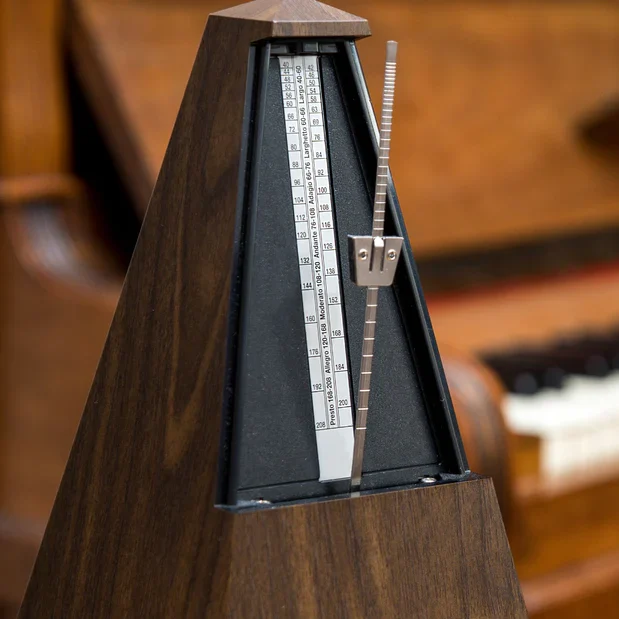
This post will outline 5 benefits of practicing with a metronome and why it has been an important and crucial practice tool for musicians for generations.
– Thomas H. Dotson

Musicians have incorporated metronomes into their practice since Johann Maelzel constructed of the devise in 1815. In fact, Ludwig van Beethoven even included exact tempo markings in many of his compositions. From my time practicing piano over the years and my experience teaching students, I have determined that the more one practices with a metronome, the faster they improve. The simple ticking devise is one of the most powerful tools for learning and musicality. I cannot recommend more that piano students practice with a metronome at least once every session.
“The more one practices with a metronome, the faster they improve.”
Corrects Note Values
Rhythm is the most vital element of music. If you merely tap out the rhythm of a famous melody without specifying the pitches, most people will be able to identify that melody. The structural integrity of a piece of music rests primarily in its rhythm and how well the other elements adhere to the metric pulse of its time signature. An incorrect rhythm of even one note can derail the flow of a section. With enough of these disruptions, a piece of music can sound jagged and cumbersome. Through practicing with a metronome, we learn to play each note for its proper value. Therefore, the downbeats of each measure will line up for a seamless cascade of music. A metronome will also polish long sections of racing notes if you play them evenly at slower tempos. The same principle for correct note values applies. If you align each group of subdivided notes with the metronome tick at slower speeds then each sequence of notes will become steady and homogenous. You should consult your teacher for correct fingerings and articulations for fast passages, but once the subdivisions are regular then you can implement artistic interpretation without your fingers stumbling over themselves.
Tracks Progress
When we practice with a metronome, we can find the level of speed where we are comfortable and then gradually increase the tempo as we progress. Hindrances within a passage can occur because of problems in our mental understanding of the music, because of physical limitations, or because of technical hurdles. Even if we are not conscious of the exact reason why a passage is causing us grief, slowing down the tempo can allow the impeding faculty to develop. If we practice a section at a specific bpm marking until we can play it perfectly before moving on, this provides an exact measurement for progress. I should note that as we practice at slower speeds, we should practice exaggerating the dynamics and articulation present within that section. But I will write about this concept in a later post.
Builds Technique and Strengthens Dexterity
When beginning a new piece of music, it is common to have problem sections. In fact, some pieces of music have become notorious of the their proverbial “problem sections.” However, by practicing with a metronome, you can tackle these sections with intention and purpose. While some students might play the easy sections quickly and then decelerate during the problem sections, practicing with a metronome will ensure that each measure is uniform. When we play the harder sections at slower speeds, we give our muscles and tendons time to strengthen. Similar to progressive overload with lifting, we increase the level as we master the previous tempo, thus our dexterity and technique graduates from that speed. The metronome will highlight technical issues wherever your playing falters from tempo. These issues must be addressed at slower speeds so that you can “work out” the weakness. Be patient with yourself as strength and proper technique at the piano take time. It is better to practice slowly until mastery than to rush into performance tempo and develop bad habits.
Enhances focus and concentration
Like a whistling drill Sargent the ticking of a metronome keeps you on task. Something about the metronome heightens my awareness when practicing. Perhaps it imitates the ticking of a clock, which cues my mind to the inexorable passage of time. Metaphysics aside, a metronome divides measures into units of time. While self-evident, this is extremely useful for practice. If we want to drill a certain passage, a metronome keeps each repetition on a specific number of beats, like a training interval. By listening to our training tool, we can condense the number of corrective iterations into a short period of time— especially if we set our metronome to mark the downbeat. If our metronome marks the downbeat then we can challenge ourselves to start every phrase on the downbeat. We attain flow much easier with a metronome because of the extra amount of attention that it requires to stay with the beat.
Prepares for Ensemble Playing
Nothing is more embarrassing than witnessing a self-proclaimed piano virtuoso fall on their face when attempting to play with other people. Unfortunately, pianists that were reared on the rubato of Chopin and irregular Impressionism will develop a bad habit of playing out of time. These students do not understand the metrical rigidity of how his music should be played (rubato only lasts for a phrase before correcting – also in order to push and pull at the tempo, you first need a definite tempo). Think about it like this, every deviation from the metronome will cause you to lose your concurrence with other musicians. However, as you practice with a metronome (especially one that marks the downbeat) you will develop an intuition for finding your place in the music after it leaves you behind. This ability to follow music even if you are not playing is essential for a musician as it could save a performance. A student who practices with a metronome will have the ability to play with others because the measures will correctly align and even without the audible ticking the student will have the habit of playing within the time signature. This skill will be invaluable as you begin to collaborate with other musicians.
Rhythm is part of the foundational structure or the integral architecture of a composition. The notes and rhythm constitute the indisputable substance of a piece of music or the “what”. A metronome delineates this crucial element of music with mechanized precision so that we can contribute our own equivocal and subjective artistry on top of an exact performance. The “how” of music is infinitely more important in imparting our music to others, especially with the advent of midi and AI. A metronome will reduce the time that you spend calculating the rhythm of music so that you can focus your time on interpretation. A metronome removes so much ambiguity out of our playing, so that we can direct our attention to our executive function of emotion and feeling.
Leave a Reply